
Skills vs Competences
These two words are often used interchangeably, but I think the distinction between them matters. Here's how I define them:
A Skill: Knowing how to do something — and being able to do it.
A Competence: Actually doing it under pressure, in real game situations.
There's a meaningful gap between being able to do something and actually doing it. At some point, the goal has to shift from learning a skill to consistently applying it. That's the moment a skill becomes a competence.
The Slapshot Problem
Consider a hockey player with the hardest, most accurate slapshot in the league. If he never uses it in a game, it's worthless — a party trick for hardest shot competitions.
For that slapshot to become a competence, the player needs to learn how to get open, and his teammates need to learn how to set him up. The skill only has value when it lives inside the game.
This also highlights a key difference in what it takes to develop each one. Learning a skill demands technique and physique. Turning it into a competence also demands instinct and hockey IQ.
The Four Steps to Competence
Competence doesn't happen overnight. It typically follows four stages:
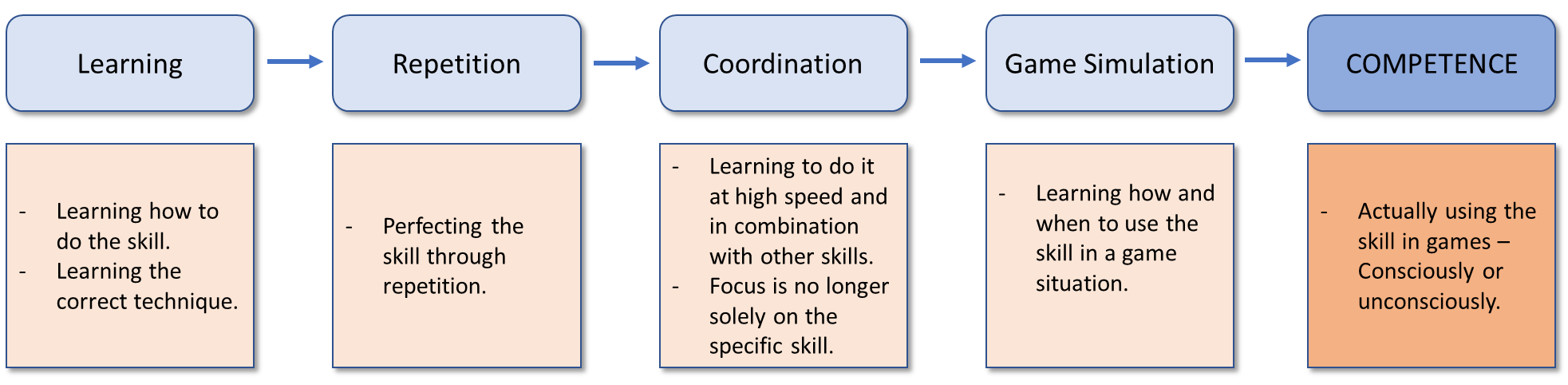
Learning — Learning how to perform the skill and mastering the correct technique.
Repetition — Perfecting it through repeated practice until it becomes reliable.
Coordination — Performing it at speed and in combination with other skills. At this stage, the player's focus is no longer solely on the skill itself.
Game Simulation — Learning how and when to use the skill in game-like situations.
Only after moving through all four stages does a player reach true competence — actually using the skill in games, whether consciously or unconsciously.
The Role of Instinct
Instinct is simply doing the right things without thinking. When a player's instincts are sharp, they don't need to calculate — they just react.
This is also why some players click immediately when put on the same line. Their hockey instincts align naturally, and neither player has to adjust their game to make it work. That's instant chemistry — and it's rooted in shared competences.
Discussion
0 comments
Log in to join the discussion.
No comments yet
The thread page is live. Add the first reply and the nesting model is in place.