
Perception – Decision – Execution: A Different Lens for Player Analysis
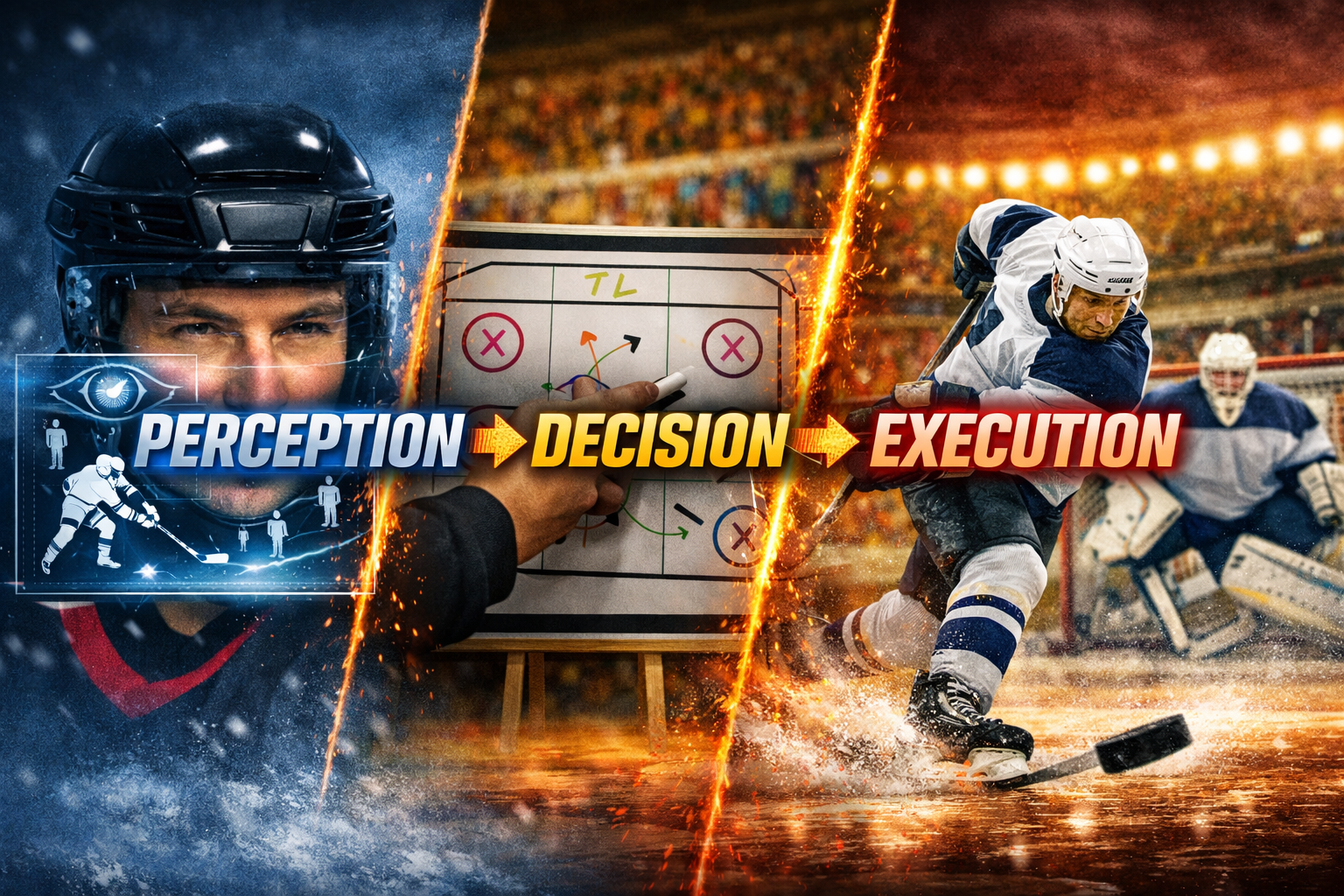
In this post, I want to explore a somewhat unconventional way to evaluate players.
It is a discussion I find very interesting, and hopefully the logic is easy to follow.
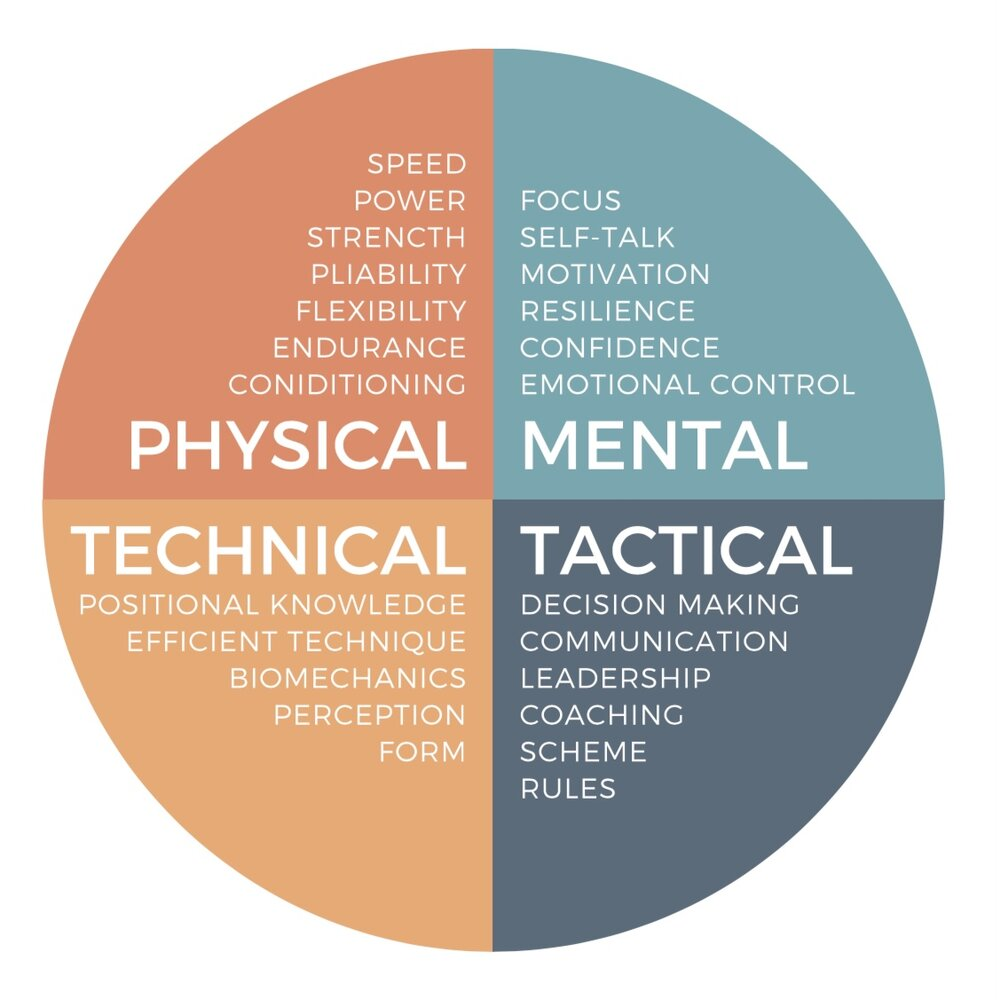
The 4 Pillars
Players are often defined through the four pillars:
- Technical
- Tactical
- Physical
- Psychological/Mental
This is a valid framework. But I also think some key parts of on-ice performance become unclear when we stay inside that model.
Defining Players Through Actions
An alternative is to define players through actions: evaluating a player’s ability to execute plays.
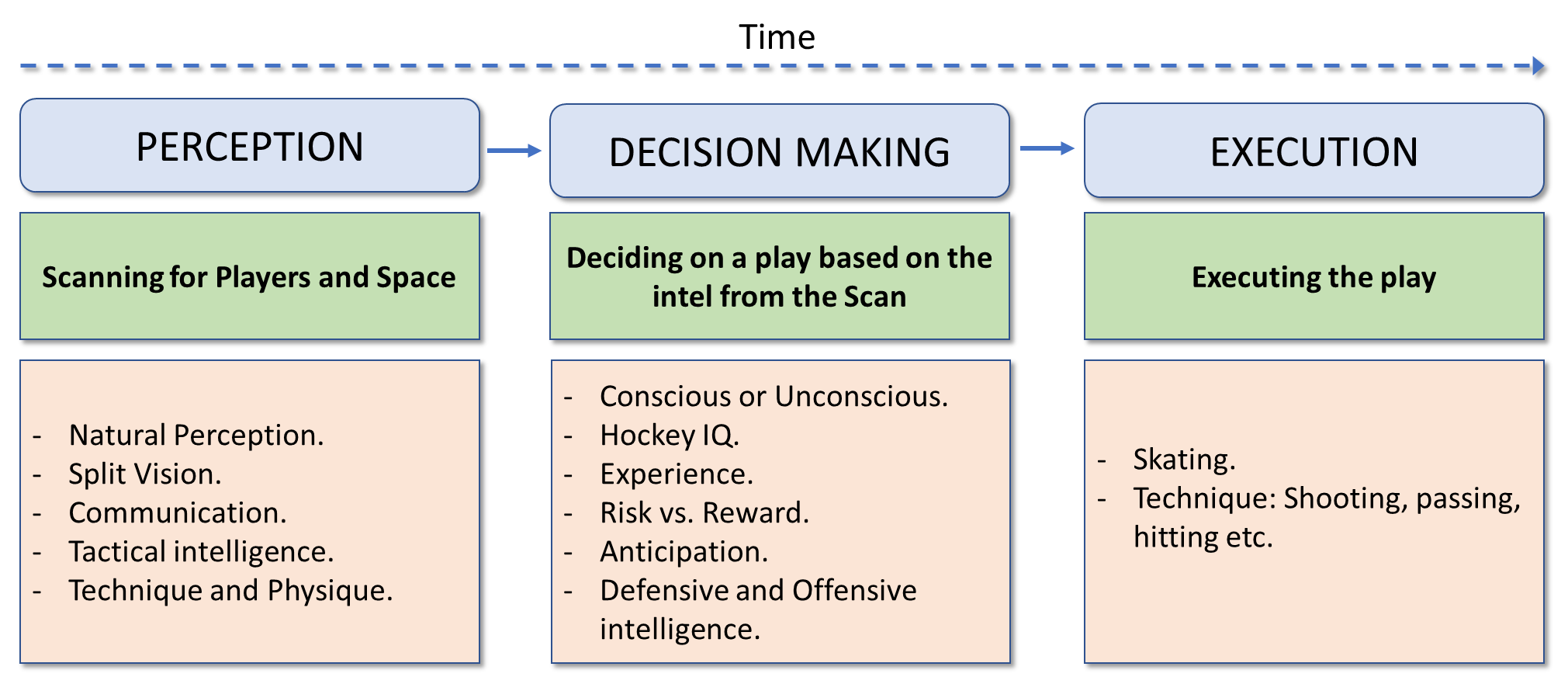
Every single action can be viewed as a three-step process:
- Perception
- Decision Making
- Execution
This is the lens I prefer.
How well does a player perceive the play? Is he making smart decisions? Can he execute?
Perception
I think there are two types of perception:
- Natural perception
- Trained perception
Natural perception is mostly innate. Some players simply process the ice faster and more clearly than everyone else.
But perception can also be trained:
- Scanning the ice with intent and focus
- Split vision (playing with your head up while controlling the puck)
- Tactical understanding (knowing where and what to scan)
- Communication (adding audio information to visual information)
If a player is technically and physically strong, he can spend more attention on perception and decisions instead of pure puck control or balance.
Decision Making
This is what we often call Hockey IQ: the quality of on-ice choices.
A few important points:
- Decisions can be conscious or unconscious (instinctive)
- Experience should improve decision quality
- Anticipation improves timing and options
- Good decisions are usually risk vs reward assessments
- The right risk profile depends on execution ability.
- A highly skilled player may benefit from high-risk, high-reward play.
- Another player may maximize value with low-risk decisions.
One more point: offensive intelligence and defensive intelligence should be viewed as separate skills. Instead of one Hockey IQ, we should often think in terms of offensive IQ and defensive IQ.
Execution
Execution is what we see directly:
- Skating
- Shooting
- Passing
- Hitting
- Puck skills under pressure
Decision quality should match execution ability.
Some players attempt plays that are too difficult for their skill level. Others play far below their skill level because they fear mistakes.
Psychological and Physical Effects
Psychology and physiology obviously impact plays.
High confidence often increases willingness to take risk and execute difficult actions
Low confidence often leads to safer, lower-value choices
Fatigue affects both decision quality and execution quality
My general view: perception is usually less affected than decision making and execution.
Is the Limiting Factor Time or Quality?
So far we have focused on how well a player performs each step.But speed matters just as much.
- How quickly can he scan?
- How quickly can he decide?
- How quickly can he execute?
A quick release is often more valuable than perfect mechanics if pressure arrives fast.
A good analogy is a quarterback facing a blitz: if you are too slow, quality becomes irrelevant because you get sacked.Same in hockey: if pressure arrives before you act, time is the limiting factor.
When time is limiting, there are two solutions:
1) Execute quicker
2) Buy more time
In hockey, players buy time by moving their feet, creating angle, protecting puck, and manipulating pressure.
It is also crucial to separate these coaching problems:
- Make better decisions
- Make quicker decisions
They are not the same skill, and they require different training.
This also helps explain why some players dominate one level (for example juniors) and struggle at the next level (pro): pressure closes faster, time shrinks, and the player cannot complete the full perception-decision-execution sequence before losing possession.
Statistical Interpretation
Can we quantify these ideas statistically?
Shot Data
Most public data is shot data.Useful for shot selection and finishing, but limited for analyzing full perception-decision-execution chains.
Possession/Event Data
If we had richer event data (passes, dump-ins, recoveries, exits, entries), we could profile player behavior much better:- What choices players make- How they execute- How much risk they take- How long they control possessions
That would bring us closer to measuring both decision patterns and play speed.
Expected Value of Situations
Expected goals values the shot. A more advanced approach would value the entire situation at any moment.
If we could estimate expected value at possession start and possession end, we could measure whether the puck carrier added or subtracted value through that possession.
That would produce a much more holistic player evaluation.
Tracking Data
With tracking data, in theory, we could model expected value continuously from puck and player locations.
That is likely the long-term direction for truly deep player analysis.
Discussion
0 comments
Log in to join the discussion.
No comments yet
The thread page is live. Add the first reply and the nesting model is in place.